
They say a picture is worth a thousand words. The best comics and graphic novels make you believe it. I love how a good comic or graphic novel can encompass paragraphs of writing with a single panel. And the medium has such a breadth to it, welcoming everything from violent vigilantes to thoughtful philosophy and everything in between. So if this list veers from one genre to another, don’t blame me: blame how awesome graphic novels are.
And if you think I shouldn’t be calling these books ‘graphic novels’, there’s a note for you at the bottom of the page.
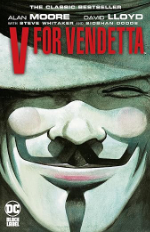
When people write these sorts of lists and they come to Alan Moore’s work, they generally opt for Watchmen instead. I don’t disagree; Watchmen is a remarkable work and kicked off a whole new era of superhero comics.
But I just prefer V for Vendetta.
It might be because I’m British. V for Vendetta is a very British comic, and obviously the Guy Fawkes imagery means more to me. But I feel that V for Vendetta is a more grounded story than Watchmen. Yes, there is a larger-than-life character at the heart of it. He even has a kinda-cape. But he isn’t super. He’s definitely not a hero.
The story is, perhaps, actually more relevant today than when it was written, even if the setting is terribly dated now. Where Alan Moore looked at Thatcher’s Britain and foretold the risks of sliding into authoritarianism, today that slide is in progress. It makes V for Vendetta all the more terrifying and brings the horror and the challenges closer to home as a result.
I will say that V for Vendetta is clearly one of Moore’s earlier works. It’s a little less certain, a bit too wordy for its own good in places. It’s sometimes a touch repetitive; I suspect that’s a result of being inconstantly published before being collected.
But it has one of the things I love about a writer’s early work: an earnest rawness that can often be smoothed out by the polish of experience.
We also recently rewatched the film adaptation, which was better than I remember. But this is, of course, the superior version.
I struggled with including this one in the list.
Neil Gaiman is not a good person. His behaviour sounds monumentally shitty. So encouraging people to read his work seems wrong somehow.
But bad people can still be talented. And, if you’re someone who can separate the author from the work, you can find a lot to enjoy about The Sandman. So I’m going to write about it. And you can decide what you want to do.
Because The Sandman is, to be honest, pretty spectacular.
The writing is often poetic. It’s beautifully, honestly written, with lines that will make you stop and think and even change the way you see the world. It makes The Sandman very easy to love.
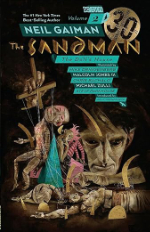
And the art is phenomenal. The Sandman series features so many talented artists, from the beautiful pencils of Michael Zulli to the sharp lines of Marc Hempel, the incredible expression of Colleen Doran to the outstanding covers by Dave McKean.
The central conceit is clever: with its main character the embodiment of dreams, The Sandman gives itself permission to explore every synonym for ‘dream’ you can imagine. Your personal nighttime imaginings, yes. But also imagination, aspiration, creation. It gives the story tremendous scope. The Doll’s House encompasses myth and legend, personal dreams, the human psyche, nightmares both imagined and real.
The Doll’s House isn’t the first storyline in The Sandman. That honour goes to Preludes and Nocturnes, which is a more traditional introduction but is a writer finding his feet. The Doll’s House was deliberately written to help onboard readers late in picking up the title, and Gaiman has his feet firmly under him by now: the story serves as introduction as well as being one of the strongest arcs in the series.
The impact and the influence of The Sandman has been huge. It’s dated somewhat since its initial release, and the pall of its creator saps some of the colour from its pages. But it’s still a remarkable piece of work. If you can read it.
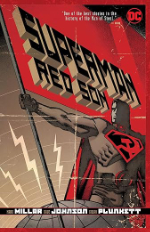
You have to wonder why no-one had thought of it before: what if Superman had landed in Soviet Russia instead of America? In Superman: Red Son, Mark Millar’s answer is simple: he becomes a champion of communism.
In the hands of another, this could have been a polemic against socialism. But Millar is a Scotsman with no particular axe to grind. What emerges instead is a story of a Superman who can make the world a utopia, but at the cost of choice. Security for the price of freedom. This is a very obvious post-9/11 work, a little too obvious at times, but still an excellent observation of the times.
Social commentary aside, this story stands up because of its protagonist. Superman has long been as American as hot apple pie and a curiously large number of guns in the closet. So you would think making him a Russian would take away everything recognisable from the character. But the best thing about Millar’s story is that Superman, at his core, is the same as he’s always been. All he wants to do is help people. Only, as Stalin’s right hand man and successor, he chooses to do so with both his power and his politics. It takes an interesting idea and turns it into, I believe, a classic graphic novel that sits comfortably in my top ten.
In fact, I think I prefer the Superman as a Soviet. He just seems more believable as a man trying to change the world than a big blue boy scout.
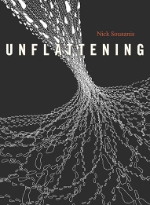
Is Unflattening a graphic novel? Not especially. It’s not even really a novel. But it’s bloody brilliant, so I’m not going to exclude it on a technicality.
Ever heard of Flatland? The story of a square that encounters a sphere. The 2D square can’t see in three dimensions, of course, so it has trouble understanding the sphere’s existence and what a 3D world is like.
Unflattening takes this concept and uses it as a prism to explore our own existence.
Unflattening is, ostensibly, a dissertation on the value of comics, the combination of the written word and illustration. But it ends up being much more than that. For example, there’s a lot of discussion about perspective. Our own eyes show us that perspective is always an amalgam: our left eye sees one view, the right another, and we assemble those two views into one.
And society, writer and illustrator Nick Sousanis proposes, has flattened us into two dimensions. We have lost the third dimensional perspective, a perspective we desperately need to regain.
The subject material is highly conceptual and, therefore, sometimes wobbles slightly on the fulcrum of self-importance; it’s tough to read something like this against the backdrop of something more grounded, like worrying about how you’re going to pay for food. But there are still so many useful perspectives and ideas that it’s worth a read. I know I’ll be rereading to remind myself in the future, and I want my kids to read it.
And I think you should read it too.
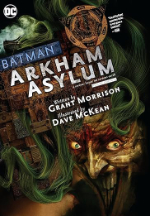
You’re going to find this title on every single list of “great graphic novels”. Sometimes, those entries are on there purely because they had a big influence on the genre, even if the story itself hasn’t held up over the years. Other times, they’re on the list because they’re just genuinely great.
Arkham Asylum is very much the latter.
First off, there’s Dave McKean’s frankly beautiful artwork. It’s not just beautiful to look at, but it’s also perfect for this story. McKean’s work doesn’t aspire to the typical “realism” you see in comics; instead, his work is more suggestive. There are more gaps, more impressions than actual representations. And it all feels less…concrete. More uncertain. Terribly apt for a graphic novel so concerned with the fragility of the mind.
McKean’s art might honestly be enough to recommend Arkham Asylum. But the other reason I recommend this book is that I very much believe Batman is bonkers. And, in Arkham Asylum, he is.
Of course Batman is bonkers! He’s a billionaire who dresses up as a damn bat and beats up criminals. He’s absolutely off his rocker. Which doesn’t mean he isn’t competent. After all, you don’t survive long running around in spandex if you’re not terribly good at it.
But insanity doesn’t equal incompetence. And Grant Morrison’s story is a nice exploration of what that means for a figure like Batman.
If you haven’t picked up Arkham Asylum and you like your Bats a little batty, this one is for you.
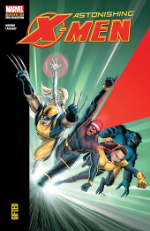
I’ll never understand people who don’t think the X-Men aren’t political.
In 2004, my biggest exposure to X-Men was the 90s cartoon (which was, admittedly, pretty awesome). But I was a huge fan of Buffy the Vampire Slayer, Angel, and Firefly. So when Marvel Comics announced Joss Whedon was going to write X-Men, I immediately asked my local comics shop (Abstract Sprocket, if you’re wondering) to hold the title for me.
Such a X-Men newb was I that I didn’t know who half the characters were (Emma Frost? Kitty Pryde? Where was Professor X? Jean Grey?) But I puzzled my way through the first issue until the bombshell was dropped: a cure.
The notion felt fresh and new back in the early 2000s, before Brett Ratner got his grubby mitts on it for X-Men 3. Whedon does a far better job of handling the character reactions. If the scale and fallout seems smaller than the big screen interpretation, it’s at least handled with more skill and heart.
Because while Joss Whedon revealed himself to be a tool, he is a skilled writer. It’s true that he didn’t really change his voice enough for Astonishing X-Men, meaning all the characters are snarky and quick-witted and maybe a little too Buffy the Vampire Slayer. But hey, they’re funny. And the tone isn’t wildly wrong; it’s just a little off at times. If you can forgive it, you’ll have a good time.
And while I’ve read plenty of X-Men since, Gifted remains one of the better explorations of what it means to be a mutant.
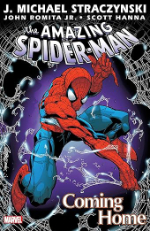
I have strong opinions about Spider-man, so you know this one must be good.
I got into this title towards the end of J Michael Straczynski’s run and enjoyed it so much I went back and ate up the backlog. (This was before Straczynski’s ludicrous Gwen Stacy/Green Goblin nonsense.) But his first arc was, I believed, his best.
Coming Home really is a new chapter in Peter Parker’s life. He starts a job as a school teacher, putting him in the position of mentor for the kids in his class. It’s a much better fit for his character, especially at this stage in his life. But this is Peter Parker; as much as he’s able to pass on wisdom, he needs wisdom to be passed to him. Enter Ezekiel, an older man who seems to have powers just like Peter.
Naturally, Peter has questions. But Ezekiel hasn’t used his powers to be a superhero. Instead, he’s used them to build a business empire. Quite how climbing walls translates into business acumen is never quite made clear…
Ezekiel does, however, introduce a whole new mystical bent to Peter’s powers. I flipping love this. It makes the radioactive spider more than a freak accident and connects Peter to something bigger. It also introduces a whole new slew of mystical villains, the first of which is Morlun. Morlun is basically a mystical vampire: he wants to eat Peter. And he’s relentless.
What I love about this story is that it could have entirely failed. Straczynski introduces a lot of new stuff that, on paper, seems at odds with the concept of Spider-man. But the execution shows that he understands the character. The way Peter defeats Morlun shows that Straczynski isn’t ditching Peter’s scientific background entirely, merely adding a new layer to it. And the panel of Peter squatting on a payphone, calling in sick to work while his costume is in tatters? It’s so perfectly Spider-man.
Speaking of panels, John Romita Jr’s art is superb. It’s expressive, energetic, and unique. Each page is an absolute treat to look at. Personally, nowhere has Romita Jr’s art fit so well as on Spider-man. This book is worth picking up just for the art, if you ask me.
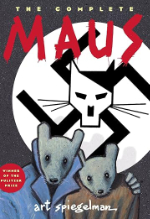
Fuck.
That’s kind of the only reaction your can have when you’re reading Maus. Because it’s an awful story told well.
Another example you’ll find on every single list of great graphic novels, Maus is going to stay on those lists until the heat death of the universe. It’s just that good.
But it’s a tough read. It shows writer and artist Art Spiegelman visiting his father over the years and listening to his stories of the Holocaust. If that wasn’t hard enough, Spiegelman’s relationship with his father is strained; many of their interactions are tense, adding another layer of sadness to a sad tale.
But Maus isn’t maudlin. It doesn’t dwell or wring the emotion out of an emotional tale. It is honest. Plain, like the artwork, yet artfully arranged. Spiegelman tells you what happened. He doesn’t need to do any more than that.
This simplicity and clarity is evident throughout. It’s the essence of Spiegelman’s achievement: telling an important story through the strength of the medium. Like portraying the Nazis as cats and Jews as mice, it could have failed in lesser hands. But Spiegelman doesn’t overegg anything. He doesn’t try to tell The Epic Tale of the Holocaust. He tells a very personal story. Which, of course, is exactly what the Holocaust was: as much as we tend to talk about its sheer, horrific, heartbreaking scale, every one of the six million was a single person. A human being who endured the unimaginable.
I hesitate to call Maus a good story, but the story is terrible. But it’s an important story told very well. And everyone should read it.
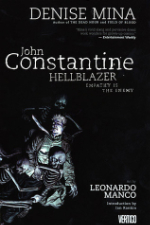
John Constantine is an interesting character. Some writers slide too easily into Cockney violence and swagger, as if he were a Guy Ritchie creation. Others lean on the magic, their stories grand and with a sweeping scope.
Writer Denise Mina treads a middle ground, an approach I personally feel is a much better fit for the character. You still get the magic and the weirdness, but it’s grounded and gritty. Artist Leonardo Manco really helps with that; their artwork is dark and almost grainy, helping to make things feel grim and all too real even when they take us to other realms.
And, to be honest, the story is a bit grim too. So dark artwork is a perfect fit. I chose ‘Empathy is the Enemy’ because it’s well-written; Mina was an established Scottish crime writer before she took on a stint on Hellblazer. But also because the twist was genuinely surprising. While we think of empathy as being a good thing, Mina reminds us there’s a dangerous edge to it too.
It’s a message even more relevant today, when we are subject to an onslaught of pain and misery and suffering, all so horrific that many are paralysed into apathy. Of course, Mina shows us that apathy is hardly the worst outcome.
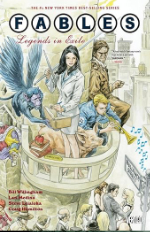
Fables is both great and terribly flawed at the same time.
It’s great because the concept and the writing is superb. All fairy tales are true, and the characters exist in far-off realms. But a mysterious dark force has forced many of them into exile in our realm. So there are pockets of fairy tale characters living here on Earth. The Big Bad Wolf, Snow White, Pinocchio, Rose Red, and so on.
You might often hear comics described as soap operas in spandex. Fables is kind of the same: the real focus is on the characters and their relationships. Sometimes we get big action. But most of the time, the stories are smaller, like ‘Legends in Exile’. This is not a criticism; the smaller stories are often taut and allow for more depth. Using the whodunnit format for ‘Legends in Exile’ is the perfect introduction to the world while providing a compelling plot.
As the series progresses, the formats get grander. Less whodunnit and more grand conflicts, battles, even epic fantasy. We journey to other realms, even start fighting back against the Adversary that drove these fables into our world in the first place. The story grows and deepens with each storyline.
The downside of Fables is the same as every other soap opera: after a time, it gets stretched. The storylines start to feel like an excuse to stretch the length of the series rather than stories that have to be told. I won’t lie, I found myself skipping storylines towards the end.
Nonetheless, Fables is a series I’ve reread multiple times over the years. It’s a great idea, it’s well written, and if it’s flawed, it’s a flaw that’s just a part of the format; you either accept it or you don’t. And if you don’t, you miss out.
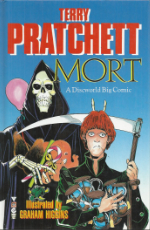
Yep. Bet you didn’t see this one coming.
Mort: A Discworld Big Comic was one of three titles published by VG Graphics, a short-lived imprint of Victor Gollancz. (I haven’t been able to find out why it was so short-lived: the other two titles were written by Alan Moore and a pre-Sandman Neil Gaiman. So it’s not like the weren’t spoilt for material.)
At any rate, this adaptation of Mort was my first introduction to the Discworld (but not to Terry Pratchett; that was his very excellent Truckers). I like Mort so much this is actually its second appearance in a blog like this (the first was in my list of 25 fantasy books you should read next!)
And if you’ve not read Discworld before, this “Big Comic” is a pretty great introduction. Graham Higgins’ art is just the right kind of gritty and fantastical, lacking the cartoonish quality some Discworld art can take on. The novel, of course, has been severely abridged. This is objectively a bad thing, because there’s less Pratchett on the page. But you can’t see the joins. So whether you’re looking for a different way to sample Discworld or a different way to enjoy a book you already love, you can’t go far wrong with Mort.
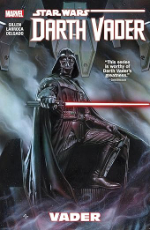
If you needed a title that looks like a copy-paste error, this is one for you.
I’m sceptical of prequels, midquels, and unplanned sequels. Too often they involve torturous twisting of the original story to make room for a story that didn’t need to be told. Sometimes they exceed all expectations (Back to the Future). Other times, they fall flat (Assassin’s Fate). When Disney bought Lucasfilm and announced comics set between Star Wars and Empire Strikes Back, I was expecting the latter.
But I was wrong.
First of all, Kieron Gillen was an excellent choice. He captures Vader’s voice almost perfectly. And his storytelling chops are clearly on show: Darth Vader starts in media res as Lucas would have done, pulling you in straight away. Gillen is also aware of how limited Vader is as a protagonist; the Dark Lord of the Sith is the strong and silent type, so Gillen immediately puts together a supporting case including a murderous pair of droids and the always-fun Dr Aphra, a female Indiana Jones in space.
And then Gillen explores the very rich creative playground left in the way of Star Wars: A New Hope: Darth Vader is the sole survivor of the Death Star debacle. He’s hardly going to get away with a slap on the wrist. Not to mention the biggest off-screen development: Vader learning that the rebel who destroyed said Death Star was his son, Luke Skywalker.
If there’s any flaws, its in the fact that there are, at times, failures in the crossover: this title was written alongside the simply titled Star Wars, which followed Han, Luke, and Leia. If you haven’t read that, there are a few moments where you’re not entirely certain as to what’s happening. The artwork in Darth Vader is also much better than the uncanny valley of that Star Wars title, but it’s weakest when portraying known faces from the original films.
Still, if you’re a Star Wars fan, this is absolutely the graphic novel I’d recommend to you.
You disagree with Alan Moore at your peril. But I do.
My main objection to the term is that usually it means a collection of six issues of Spider-Man, or something that does not have the structure or any of the qualities of a novel, but is perhaps roughly the same size.
Alan Moore, quoted in Locus magazine July 2003
And look, he’s not wrong. A graphic novel should be a story designed to be told in the total page count of the eventual print product. A story told in a series of comics is a different thing.
Except that graphic novel is widely used to describe any printed book of sequential storytelling, whether that’s a graphic novel or a comics collection. I could be a linguistic purist or I could use language the way everyone else is using it. So I do agree with Alan Moore. Just not enough to use the term ‘graphic novel’ the way he wants me to.