
“You’ve made a spelling mistake.” “I always thought it was spelt ‘elves’.” “Why are you spelling it like that?” I’ve had a few questions along these lines in the lead-up to publishing The Fey Man. It’s no surprise, because they’re all correct: the plural of ‘elf’ these days is indeed ‘elves’. But it didn’t used to be that way, not until J. R. R. Tolkien came along.
You ignore Professor Tolkien at your peril, for he was a very smart man.
Tolkien is responsible for ninety percent of all fantasy tropes, or so it seems, and he addressed the question of the plural in the appendix of The Lord of the Rings, where he admits:
“…dictionaries tell us that the plural of dwarf is dwarfs. It should be dwarrows (or dwerrows), if singular and plural had each gone its own way down the years, as have man and men, or goose and geese.”
He goes on to say that he instead chose dwarves as a way of distancing his creations from “sillier tales”; he didn’t want readers to think of children’s stories of little people.
(As an aside, I would have loved to use dwarrows as a plural for dwarf. It’s a fantastic word but, alas, I think it would have been unnecessarily confusing.)
So why am I using a form Professor Tolkien (who you ignore at your peril, for he was a very smart man) thought was associated with silly tales? To put it simply: I want you to think of fairy tales when you read The Fey Man.
Fairy tales are such fluid things, continually appropriated and modified to suit new purposes.
Many writers of fantasy follow Tolkien when they create their worlds: they draw on old mythology, often Norse but also Chinese and Christian and Hindu and so on. Mythology is a fascinating subject, but the gods and heros are so grand and dramatic they tend to overshadow perhaps the most pervasive mythology: fairy tales.
Fairy tales are interesting creatures. We all know the tale of Little Red Riding Hood, don’t we? Except we may not know that older versions of the story had the wolf bake Grandma into bread and feed it to Little Red. Or that the wolf had the girl throw her clothes on the fire before she climbed into bed. Fairy tales are such fluid things, continually appropriated by each generation and each new culture and modified to suit new purposes. Even now we’re creating darker versions of the tales we know. Fairy tales, in all their guises, are a big influence on the Realm Rift Saga and they resonate with the story on a number of levels.
That’s why the spellings Tolkien popularised didn’t seem to fit my novel. They suggested too much the fantasy worlds that had come before. I wanted something that seemed a little quaint, a little English, a little fairy tale. The elfs are still a race not to be trifled with. The dwarfs still demand respect and admiration. But they help give a little flavour of what I hope feels like a different world.

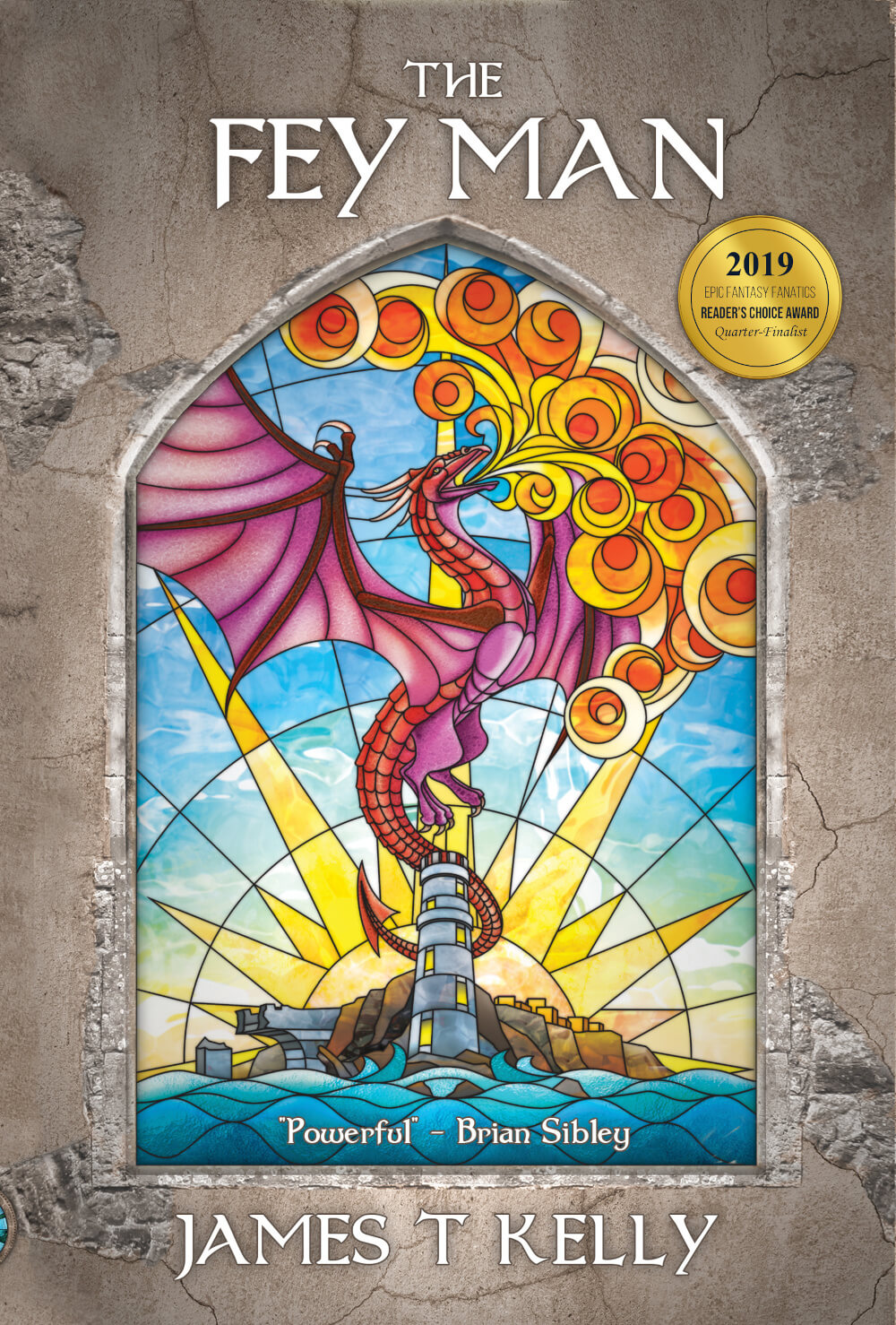
A land plagued by dragons. A sword only he can wield. A quest that could save his realm or doom it forever.
Thomas Rymour is the prophet who cannot lie, in service to a powerful duke. But when an elf lord hatches a plot to steal a legendary sword, Tom is forced to break his oath in order to save the world.
On the run from armies and dragons, Tom discovers the sword is the only thing that can stop the oncoming war, and he is the only one who can wield it. But while terrifying dragons scorch the skies, the immortal creatures of Faerie hatch their own dark plans for the mortal realm.
Can Tom find a way to save the mortal realm? Or will he fall foul of Faerie plots?
“The Fey Man immerses the reader in a compellingly conceived alternative realm created with a powerful sense of character and place.” – Brian Sibley, writer of The Lord of the Rings BBC Radio Drama
The Fey Man is the first book in the epic Realm Rift Saga. Download your copy today.

★★★★★ “This is one of the best epic fantasy books that I have read.”
★★★★ “As a study of a man in the throes of addiction, or maybe withdrawal…[Thomas Rymour] was particularly well drawn.”
★★★★★ “I smashed through this quickly as it's a real page turner and enjoyed it thoroughly. The setting is familiar enough that entering it is enjoyable and welcoming and at the same time novel enough that you care about the characters and the plot.”